
Non-Comedogenic Sunscreen When Dry Skin Still Breaks Out
What non-comedogenic sunscreen ingredients do for dry, acne-prone skin, with SPF and hydration facts for SKIN1004's water-fit sun serum.
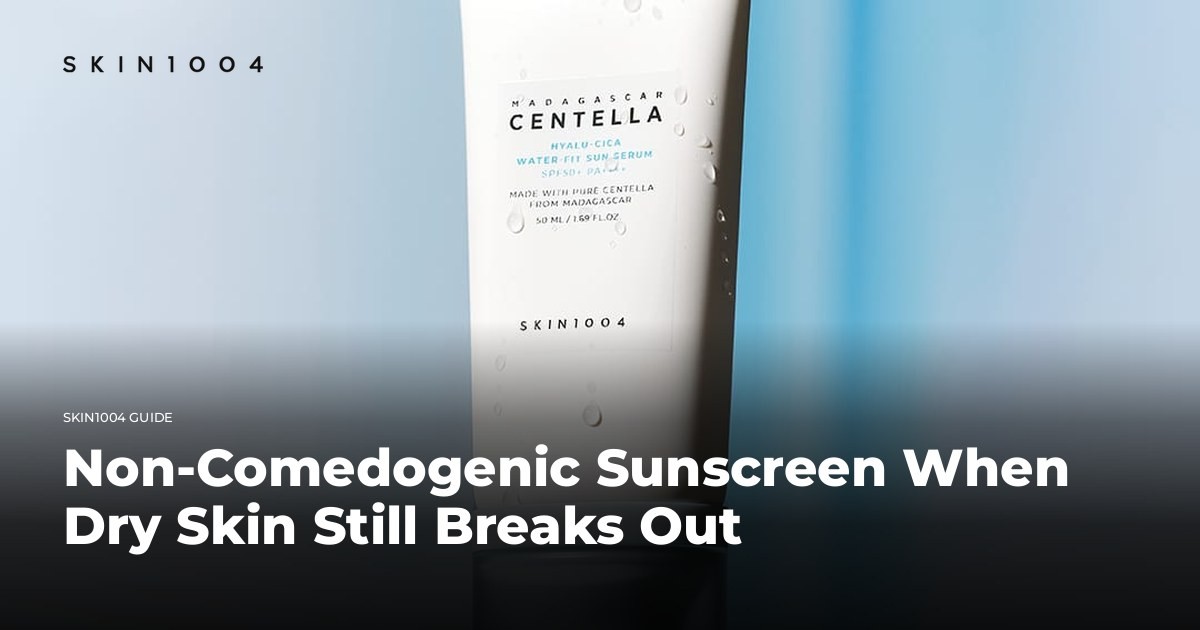
SKIN1004 Hyalu-Cica Water-Fit Sun Serum costs USD 17.10 and is formulated to sit between sunscreens that clog pores and sunscreens that leave dry, acne-prone skin tight and flaking. Skin that is both dry and breakout-prone needs a sunscreen that filters UV without heavy oils or occlusive waxes, while still replacing water the skin barrier is losing.
What makes a sunscreen non-comedogenic
Comedogenic reactions usually come from heavy, occlusive oils and waxes that sunscreens use to disperse UV filters or to leave a silkier finish. A gel, fluid, or serum-type base that relies on water and light humectants instead of thick oils tends to leave less residue inside the follicle. This is why formula texture, not the SPF number itself, is the first thing to check when a sunscreen keeps breaking skin out. Humectants such as glycerin, panthenol, or hyaluronic acid derivatives pull water into the surface layers and support the same barrier that oily, occlusive bases can disrupt, so a water-based sun formula can protect against UV and still hydrate dry patches at the same time.
The second variable is UV coverage itself. SPF measures protection against UVB, the wavelength responsible for sunburn, while a separate UVA rating (PA in the Korean and Japanese systems) measures protection against the longer wavelength linked to pigmentation and photoaging. A sunscreen that only reports a high SPF without a matching PA or UVA-PF value leaves a gap in daily protection, which matters for acne-prone skin that is also dealing with post-inflammatory marks that UVA light can darken further. In numbers: a 42-ingredient list, SPF50+ PA++++, 15ml, 50ml, 100ml sizes. The ingredient list has no fragrance or essential oils, so skin that reacts to scent can use it comfortably.
How the formula performs on protection and hydration
SKIN1004 Hyalu-Cica Water-Fit Sun Serum carries SPF 50.5±7.1 in a human in-vivo SPF test (n=10, back-area test site) and PA++++ coverage, with an in-vivo Protection Factor of UVA (PFA) of 16.56±2.69 (n=10) and a PPD-method UVA Protection Factor of 17.3 (n=10, 10 Caucasian adult volunteers, skin type II-III, ages 22-60). An in-vitro ISO 24443 test on PMMA plates recorded a critical wavelength of 376.0 nm and an in-vitro UVA-PF of 14.9 (SD 0.4, n=4 plates), the kind of UVA marker that confirms the SPF number is backed by matching UVA coverage rather than standing alone.
On the hydration side, a Corneometer measurement in a dry-environment test went from 47.45 A.U. before application to 80.52 A.U. after application, and stayed at 79.21 A.U. once the dry environment was applied afterward, a 69.527% improvement rate (n=20 adults aged 20-60). A separate 100-hour hydration study showed Corneometer readings rising from 42.38 A.U. before use to 71.32 A.U. immediately after application, a 72.090% improvement, and the effect was still measurable 100 hours later at 45.73 A.U. (n=20 adults aged 20-60). A deeper-layer moisture reading using MoistureMeterD Compact also moved from 49.38% before use to 50.86% after two weeks of use (n=20). A patch test on 30 adult subjects using the ICDRG method recorded a mean irritation score of 0.00 (n=30, 4 days).
For everyday wear on dry, breakout-prone skin, the water-fit texture of Hyalu-Cica Water-Fit Sun Serum is built to absorb without the slip or cast that heavier sun creams leave, which is the texture profile that tends to sit better under makeup and avoid the clogged-pore feeling that thick, oil-based sunscreens can cause. Because the formula is water-led rather than oil-led, it can be layered over a lightweight moisturizer on dry days without adding the extra occlusion that triggers breakouts for some skin types.
Applying it so protection and hydration both last
Sun protection depends on the amount applied as much as the formula itself. According to the American Academy of Dermatology, adults should use about one ounce (a shot-glass amount) to cover exposed skin and reapply roughly every two hours, or immediately after swimming or heavy sweating; the full-body guidance applies the same logic to a face-only serum at a proportionally smaller amount, applied generously rather than dabbed on thinly. Thinning out the layer to avoid pilling under makeup reduces the UV filter concentration on skin and should be avoided; instead, let each layer settle for a minute before applying the next step, including a second sunscreen layer at midday.
For dry, acne-prone skin specifically, apply Hyalu-Cica Water-Fit Sun Serum as the last step of a lightweight morning routine, after a hydrating serum and before makeup, and use the same full-coverage amount for reapplication rather than a thin touch-up layer. Since the formula's hydration data was measured over 24, 48, 72, and 100 hours of repeated environmental exposure, skin that tends toward both tightness and congestion can get sun protection and moisture support from one step instead of layering a separate heavy cream underneath. Keeping application generous and reapplication consistent matters more for both UV protection and comfort than switching formulas based on texture alone.
The 50ml bottle is also available as a smaller 15ml size and as a twin pack for anyone who wants to split use between a bag and a bathroom shelf, which keeps the product fresh for the full stretch of a hot season without rationing a single bottle. Checking the Hyalu-Cica Water-Fit Sun Serum official product page for current size and pricing before buying is the simplest way to confirm the figures above still apply at the time of purchase.
For the Water-Fit Sun Serum, see also Non-Comedogenic Sunscreen for Dry, Acne-Prone Skin and Sunscreen Breakouts on Dry Skin: Which Layer to Change.